
Never ignore the edges of your patches and choose the perfect border for every patch you customise. The edges of the patches don’t just provide aesthetics, but they make ensure the durability of the badge. However, there are different patch border types available in the industry. But when you pick merrowed border edge patches, they never disappoint you. If you want to perfect finishing and want your patch to last long, always go with merrow border patches.
In this guide, we will compare different styles of patch borders and let you choose what suits your needs. We will show the difference between merrowed, heat cut and embroidered patch edges. So let’s start discussing the main topic of the day.
What is a Merrowed Edge?
There are so many names for merrowed edges; some people call this overlock, or others know it as merrow edges. Meanwhile merrow border is the stitched edges that go around the corners of the patches. The benefit of merrowed edges is that they give durability while avoiding any fraying.
If you are wondering why this method became popular with this name, Merrow Sewing Machine is a company name who designed the merrowed edge stitching.
Merrowed Edge vs Heat Cut Edge: Choosing the Perfect Patch Border
Despite merrowed edges and heat-cut borders being both famous for their durability, select the one which suits your needs. Because the durability of the patches, the appearance and usability all depend on the patch edges you choose. Both of these styles let you design perfect borders for patches based on their types, materials and complexity. Here is the comparison between Merrowed edge patches and Heat cut border patches:
| Feature | Merrowed Edge | Heat Cut Edge |
| Look | Thick, raised, polished; classic finish | Thin, flat, seamless; blends with garment |
| Best Shapes | Simple shapes: circles, squares, ovals | Complex or irregular shapes, die-cuts |
| Durability | Highly durable, resists fraying | Less durable, edges may fray |
| Thickness | 2–3mm | ~1mm |
| Cost | Lower | Slightly higher |
| Ideal Uses | Everyday use, first responders, sports teams | Logos, artistic/custom designs, unique shapes |
| Advantage | Adds structure and longevity | Allows creative, seamless designs |
Perfect Patch Shapes & Styles for Merrowed Borders
If you prefer a neat, durable finish and clarity in your patch borders, then choose merrowed edges. However, it all depends on the shapes of the patches and the styles you work on, such as cotton, polyester or leather. Always select the right design, shape and style for a perfect border of the patch.
Patch Shapes That Shine with Merrowed Edges
You can transform a simple patch shape into a beautiful finishing just by applying merrowed edges. When you customise your patches with perfect merrowing techniques, it hides the extra lines and avoids fraying.
Best Shapes for Merrowed Borders:
Here are a few shapes you can pick for your patches and apply merrowing for durable edges:
- Circles: For clean, stitched curves and a polished appearance, you can choose Circle shapes, which look professional.
- Ovals: Ovals hold the stitching consistently along the long curves, keeping the patch neat.
- Squares: For a stunning, sharp corner for your patches, you can choose a square, which lets you present text and logos perfectly.
- Rectangles: Rectangular patches with graphics or wording look tidy and aligned.
- Rounded-edge polygons: Curved edges allow the stitching to flow naturally, enhancing the patch’s appearance.
Shapes to Avoid:
You should avoid these few shapes if you want to use merrowed edges for the patches:
- Stars: Sharp points make stitching uneven and difficult to maintain.
- Flames: Intricate curves can cause messy stitching and uneven edges.
- Jagged edges: Irregular cuts may fray or weaken over time.
- Highly detailed shapes: Complex cut-outs are better finished with embroidered or laser-cut borders for precision.
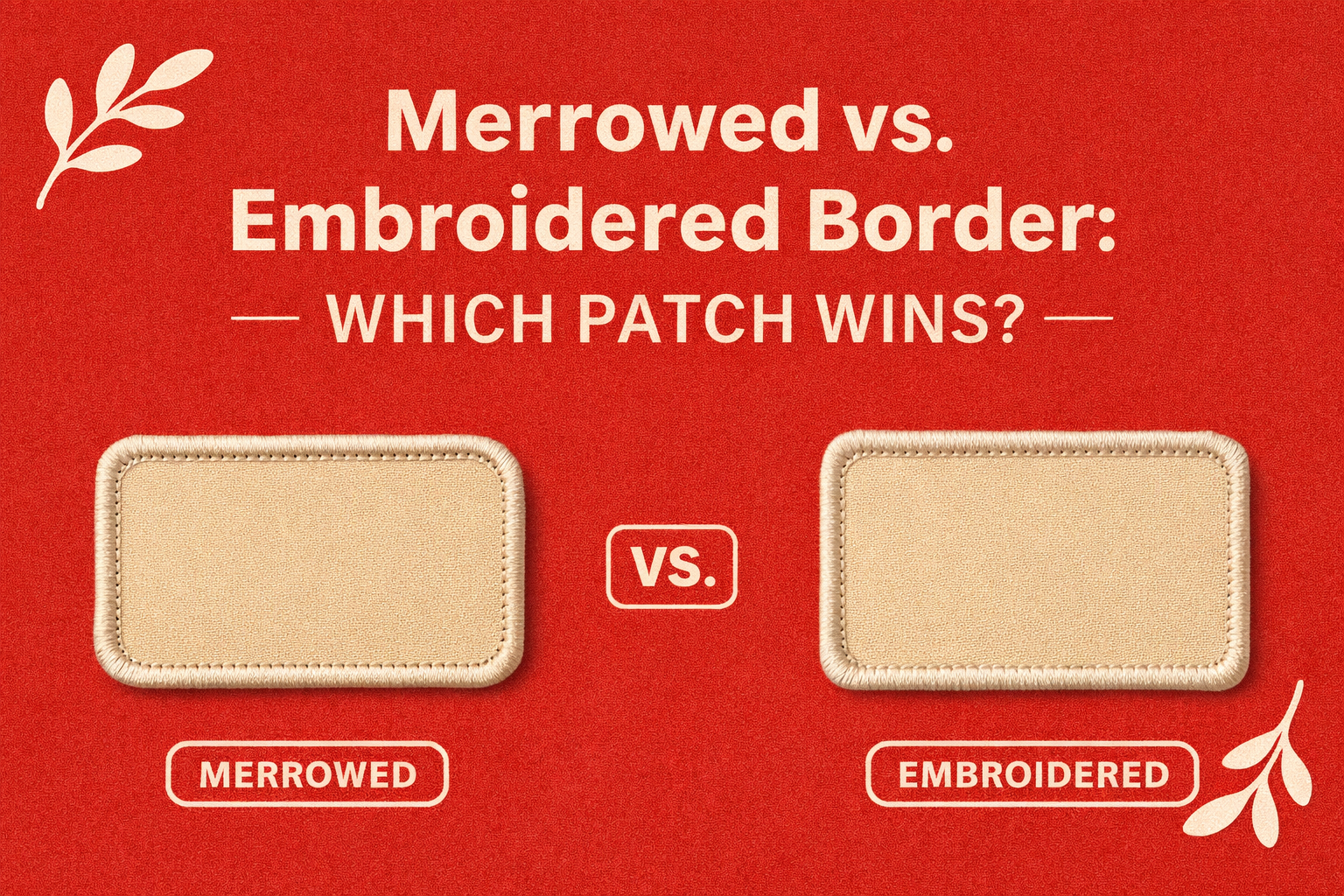
Merrowed Edge vs. Embroidered Border: Choosing the Perfect Patch Finish
You should understand the basic difference between the two types of stitching borders for the patches because not all the border styles look perfect on different types of patches. If you are confused about choosing either embroidered or merrowed patches, then here is a simple comparison for you:
| Feature | Merrowed Edge | Embroidered Border |
| Best For Shapes | Standard geometric shapes like circles, squares, ovals, and rectangles | Complex, irregular, or intricate shapes like stars, flames, and custom designs |
| Durability | Highly durable, prevents fraying, ideal for long-term wear | Moderately durable, edges can be prone to wear over time |
| Look & Finish | Raised, polished, and clearly defined; creates a clean frame around the patch | Blends seamlessly with the patch design for a smooth, integrated appearance |
| Customization | Limited to patches with simple, standard shapes | Works for all patch shapes and designs, including detailed or unusual forms |
| Ideal Use | Patches for jackets, uniforms, backpacks, or items needing reinforced edges | Patches where design complexity or seamless integration is more important than edge thickness |
| Color Options | Can use contrasting border colors for a defined edge | Border color typically matches the patch design for subtle effect |
| Key Advantage | Provides structure and longevity, perfect for bold, classic patches | Allows intricate designs without restricting the shape; perfect for creative freedom |
Patch Types That Pair Perfectly with Merrowed Borders
Various types of patches go great with merrowed edges, provide durability and look awesome. Moreover, when you sew these types of patches, it prevents fraying and frames the patch.
Best Patch Types:
- Custom Embroidered Patches: Raised textures are framed neatly, keeping the design edges clean and professional.
- Custom Chenille Patches: The fuzzy texture appears bolder and more defined with a smooth stitched edge.
- Custom Woven Patches: Detailed designs maintain clarity and sharpness with a reinforced border.
- Custom Printed Patches: Borders add depth and structure, enhancing the overall look of printed graphics.
Patch Types That Don’t Work Well:
- Custom PVC Patches: Flexible rubber patches do not require stitching and may not hold a merrowed edge.
- Custom Leather Patches: Thick leather can be damaged or distorted by overlock stitching.
- Custom Sublimated Patches: Photo-quality prints look best with clean-cut edges rather than a stitched border.
Why Choose a Merrowed Edge Patch?
People prefer merrowed-edge patches for their durable stitching and amazing finishing. Instantly transform your boring patches into a professional-looking patch with meandering edges. This overlocking technique lets you protect the patch, give your patches a polished appearance and make them long-lasting.
Adds extra durability by preventing fraying on edges.
- Gives a professional, raised look that enhances the patch design.
- Works best with embroidered and woven patches, fitting most standard shapes.
- Affordable and long-lasting, making it ideal for bulk orders.
Final Thoughts: Buy Best Merrowed Edge Patches Today!
After understanding what merrowing is and the purpose of merrowed edge patches, you can choose your favourite border patch types. Whenever you want to compare heat-cut, embroidered or merrowed edge patches, you know what you need after reading this detailed guide.
Order customised merrowed border patches in Canada with low prices and high-quality materials. Let’s start working on your merrowed edge badges. Contact CustomPatchMakers.ca right now!
FAQs
How does a merrowed edge differ from a satin edge?
Let’s compare the satin edges to the merrowed borders, and then you can choose what suits your needs. Here is the comparison between both, and it’s important while designing custom patches:
Merrowed Edge: Durable and Professional
In merrowed edge patches, they are designed using a special machine which wraps the thread around the patch’s edges. In this process, you get durable borders for your patches, and it prevents fraying and hides extra lines. If you need clean, polished and durable finishing in your customised patches, choose merrowed borders.
Satin Edge: Sleek and Detailed
On the other hand, satin edges are a simple stitching process in which you can directly sew on the patches. If you are a fan of smooth, clean finishes and an easy-to-do method, you can go with satin edges. Mostly recommended for a modern and refined appearance without extra bulk.
How is Merrowed Borders Made?
Merrowed borders are usually stitched by a certain machine, which wraps the thread around the patch edges.
- Cutting: The patch is trimmed to its final shape.
- Overlocking: Thread is stitched around the perimeter, encasing raw edges.
- Finishing: Loose threads are removed, and the patch may be heat-sealed or ironed.
This process is designed to make sure the patch is durable, clean, and professional-looking
What does “Merrowing” Mean on Fabric?
Merrowing or overlocking is the process in which the thread wraps around the edge of the fabric and makes a strong and clean seam. Additionally, it was invented in the 1870s by a company called Merrow Sewing Machines. The advantage of merrowing is that it avoids fraying and gives a durable finish.
How can I tell if a merrowed border is right for my patch?
Before you choose merrowed edges for your patches, you need to understand a few things, such as shape, durability and material of the patches.
- Patch Shape: Works best for circular, square, oval, or rectangular patches. Sharp corners or cut-outs are better suited to laser-cut or standard embroidered borders.
- Durability: Ideal for patches on jackets, backpacks, or uniforms where wear and tear is expected. Less necessary for display or collectable patches.
- Material: Embroidery and chenille patches pair well with merrowed edges. PVC, leather, and sublimated patches usually need different finishes.
- Border Look: If you want a thick, raised, and defined edge, merrowing is perfect. For a subtle transition, an embroidered border may be better.