
As you begin searching for a partner to help you design custom branding for your business, club, or team, you’ll soon find yourself encountering the term “MOQ.” While the term can be a bit of a speed bump for many Canadians looking to start a new venture, understanding the process of Minimum Order Quantities and the reasoning behind them is the only way to ensure you’re getting the most out of your investment.
At Custom Patch Makers, we believe in being transparent with our customers. Whether you’re a startup out of Vancouver looking to get a small batch of PVC patches or a security firm out of Toronto looking to get a large number of embroidered emblems, understanding the reasoning behind the MOQ can get you the most out of your investment.
What Exactly is a Minimum Order Quantity?
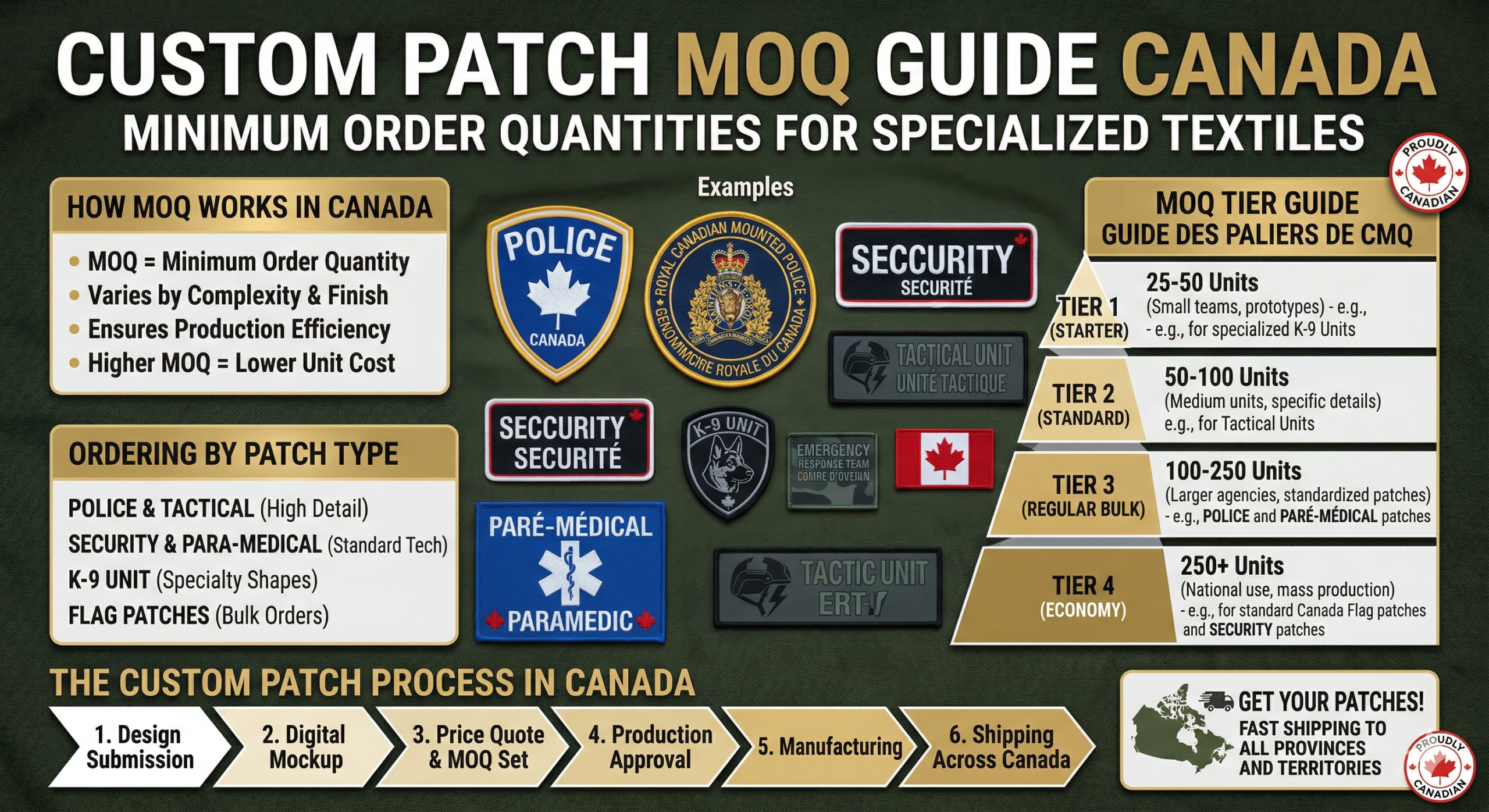
In other words, MOQ is the minimum quantity of products a manufacturer is ready to produce in one go. In the patch industry, these numbers are not arbitrary in nature. Instead, they are determined based on the amount of work involved in converting an image from a digital format to a physical object made of fabric or rubber.
For every order, there is a “setup” process involved. If the MOQ were set to one, the labor costs involved in the setup process would make the patch extremely costly for the customer.
Why Do Manufacturers Require a Minimum?
It is helpful to think about this process that happens before even a single stitch is sewn:
- Design Mapping (Digitizing): Someone has to “digitize” your logo, or interpret it into a language that the embroidery machine can read, and determine the exact placement of every needle.
- Machine Setup: The high-speed machines that sew these stitches need to be threaded individually with the exact colors that you need for your logo. If your logo uses six different colors, six different spools of yarn need to be threaded through the machine and adjusted for tension.
- Physical Molds: For something like a PVC patch, a mold is literally made out of steel or brass that will be used to stamp out the finished product. These molds are expensive to make and are designed to be used hundreds of times.
- Material Waste: The first “test” patches are often thrown away to make sure that everything is perfectly lined up before production begins.
The Secret to Saving: Volume vs. Unit Price
The most important thing that a Canadian consumer needs to know is that, as your order size increases, your price per patch will actually decrease. This concept is called “economies of scale.”
If you only order 15 patches, that might cost you $9.00 per patch. But if you order 100 patches, that might cost you $3.00 per patch. If you have a long-term plan for your branding, it’s actually much cheaper to order a year’s worth of patches at once rather than making four small orders throughout the year.
Typical MOQs by Patch Type
As materials differ, so will the amount of work required, thus affecting the MOQs you’ll find across Canada:
These are the most common type. With the process being relatively simple with current technology, MOQs can be as low as 10 to 25 units.
With a custom-made metal mold required, the cost will be much higher. MOQs will typically be around 50 to 100 units, depending on the manufacturer.
With much thinner threads, detail work is excellent. The looms used for weaving are massive, taking a long time to “warp” (prepare) threads, thus requiring a minimum order of 50 or 100 units.
With lasers and heat stamps, which don’t involve much threading, MOQs can be as low as 10 units.
Why “Low MOQ” is Great for Canadian Startups
While buying in bulk saves money, there are times when a small order is actually the smarter move:
- Testing the Waters: If you’re a new brand, you might want to see which color or design your customers actually like before committing to hundreds of units.
- Limited Edition Runs: Creating a sense of “rarity” by only making 20 of a specific design can actually drive up the value of your merchandise.
- Special Events: If you’re hosting a one-time tournament or a small corporate retreat, you may only need exactly 30 patches.
- No Storage Issues: You don’t have to worry about boxes of unsold inventory sitting in your basement or office.
How to Get the Best Deal on Your Order
If you’re working with a tight budget, keep these three tips in mind:
- Watch Your Colors: The fewer thread colors you use, the faster the setup. Sticking to 5 or 6 colors can sometimes help you negotiate a better rate.
- Stick to Standard Shapes: Custom “die-cut” shapes look great, but standard circles or rectangles are often cheaper because the manufacturer already has the cutting tools ready to go.
- Choose the Right Backing: Standard “sew-on” patches are the most affordable. Adding Velcro or iron-on adhesive adds a small cost to every single unit.
The Benefit of Ordering Within Canada
It might be tempting to try to find the absolute lowest price, and in many cases, this means looking abroad for a provider. However, when you use a local provider like Custom Patch Makers Canada, there are many hidden benefits to your bottom line:
- No Border Surprises: You won’t be caught off guard by unexpected customs charges, brokerage fees, or foreign exchange rate fluctuations.
- Reliable Shipping: You’re not waiting for a shipping container to cross an ocean before your patches arrive.
- Clear Communication: You won’t be waiting for time zone differences and language barriers if you need to make a quick change to your patch.
Finding the Right Balance
You don’t have to be a big company to attain professional patches. In fact, for small clubs and businesses, the “sweet spot” for purchasing patches is usually between 50 units. This will allow you to get a discount without having to purchase more than you can handle.
Ready to see your creation on a professional patch?
Contact Custom Patch Makers today, and we can help you determine how many patches you’ll need for your project.